From Dust to Disaster Understanding Combustible Dust Hazards
Combustible dust is a hidden hazard found in many industries, including food processing, agriculture, woodworking, and manufacturing. When fine dust particles become airborne and encounter an ignition source, they can create devastating fires or explosions.
- Manufacturing
- Logging and Forestry
- Construction
- Inspection
- Safety Programs


Fine, ordinary-looking dust can accumulate quietly on beams, equipment, and floors until a single disturbance turns it into a devastating hazard. Combustible dust explosions have destroyed facilities, shut down operations, and taken lives, often in industries that never considered themselves “high risk.” From food processing and agriculture to metalworking and plastics, explosive dust hazards exist far beyond heavy manufacturing. Understanding this risk is the first and most important step toward preventing a catastrophic event.
What is combustible dust?
Combustible dust is fine particles of solid materials such as plastic, rubber, fertilizer, metal, chemicals, grain, wood, paper, sugar, food and animal feed. The danger arises when this dust becomes airborne and mixes with oxygen, creating an explosive atmosphere. Dust is fuel. The air includes the oxidizer. Now all you need is an ignition source for a tragedy to occur.
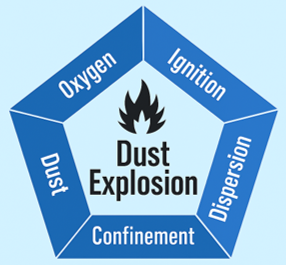
A combustible dust explosion requires five elements (the Dust Explosion Pentagon):
 The Science Behind the Danger
- Fuel (dust)
- Oxygen (the air)
- Ignition source (bearings, light bulb, electric motor, etc.)
- Dispersion (the cloud of dust in the room)
- Confinement (an enclosure such as a room, piece of equipment, or ductwork)
On July 29, 2025, a wood dust explosion at Horizon Biofuels killed an operator. The incident began when a release of wood dust from one of the buildings ignited, triggering an explosion and structural collapse. This was compounded by the fact that the operator had brought his young daughters to work that day. They were in the breakroom when the explosion occurred killing the children and their father.
Prevention
The first steps to preventing dust explosions are understanding what types of dust are present in your environment, where they are generated, and how hazardous they may be.
For example, sugar mills, feed milling, dry food production, storage, and transfer operations can produce significant amounts of combustible dust. These processes typically represent the highest-risk areas in the facility.
Next, determine the severity of the hazard. Ask key questions:
- Is dust generated in large quantities?
- Is it accumulating on surfaces or equipment?
- Are there hidden or hard-to-reach areas where dust may collect unnoticed?
- Is there any equipment that is hard-to-reach and can generate heat, such as switches, motors, and bearings?
Dust layers of 1/32 of an inch or more, about the thickness of a paperclip, are considered excessive. When disturbed, this accumulated dust can become airborne and create conditions for a fire or explosion. A small dust explosion can then cause more dust to become airborne, resulting in a larger conflagration through the facility.
Once identified, combustible dust hazards need to be addressed using the hierarchy of controls, starting with Engineering Controls and working your way down to personal protective equipment (PPE). Eliminating the hazard through engineering controls is always the best practice. This could involve changing the process to eliminate or reduce dust generation as much as possible. The dust that remains must be controlled. Depending on the process, this may include exhaust ventilation, mineral oil systems, ducting, and effective housekeeping. Each of these controls has the potential to introduce additional hazards that must also be addressed, particularly in ducting which can remove dust from the area but then accumulate within the ductwork or elsewhere. Using the right types of lighting, tools, and machinery is critical to control potential ignition sources in potentially explosive dust environments (Class II).
Combustible dust incidents are preventable, but only when the hazard is recognized. Dust that is allowed to accumulate, migrate, or remain hidden creates conditions where a minor event can escalate into a fire or explosion. Awareness leads to better housekeeping, smarter inspections, and safer decisions. By identifying dust hazards early and addressing them consistently, organizations can protect their people, their property, and their operations from this significant, but often misunderstood hazard.
More from MEMIC
Other Resources
More for You
Recent Blog Posts
Preventing Injury from Heavy Equipment in Many Industries
Anna Hooper, Safety Management Consultant, CSP, WCP®
October 14
- Construction
- Logging and Forestry
- +1

Heavy equipment hazards are often associated with construction and excavation projects. However, many organizations outside of traditional construction industries regularly encounter heavy equipment exposures that can be overlooked.
Speaking Up for Safety During Hospitality Events
Zach Phelan, Loss Control Consultant II, GSP, WCP®
September 24

From lifting heavy equipment to navigating crowded event spaces, young hospitality workers face a variety of safety challenges during the busy fall event season. Discover practical ways employees and supervisors can work together to prevent injuries before they happen.
Reducing Slip, Trip, and Fall Risks in Schools
Jayson Hebert, Safety Management Consultant, WCP®
September 2
- Education and Schools
- Slips Trips and Falls
- +1

Very soon faculty, staff, and students will be returning to schools across the country as they prepare for another year of learning. Schools are busy environments where students, employees, and visitors are constantly on the move. And, while much attention is focused on student safety, the leading causes of workplace injuries for school employees continue to be slips, trips, and falls.
Stay Connected
Sign up and we'll keep you posted on upcoming events, news, and more.
- Expert Safety Advice
- Company News
- Community Impact Stories